PRESS RELEASE
Philippine Embassy, Canberra
1 Moonah Place, Yarralumla, ACT 2600
www.philembassy.org.au *Tel. No. 02-6273-2535*
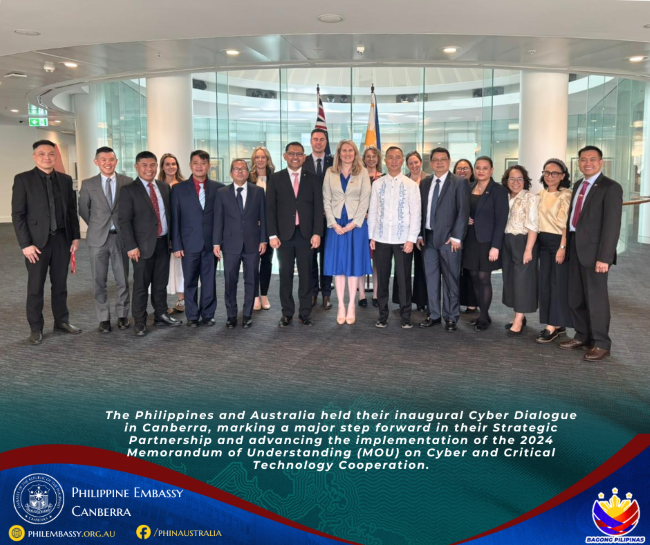
CANBERRA 09 December 2025 – The Philippines and Australia held their inaugural Cyber Dialogue in Canberra, marking a major step forward in their Strategic Partnership and advancing the implementation of the 2024 Memorandum of Understanding (MOU) on Cyber and Critical Technology Cooperation.
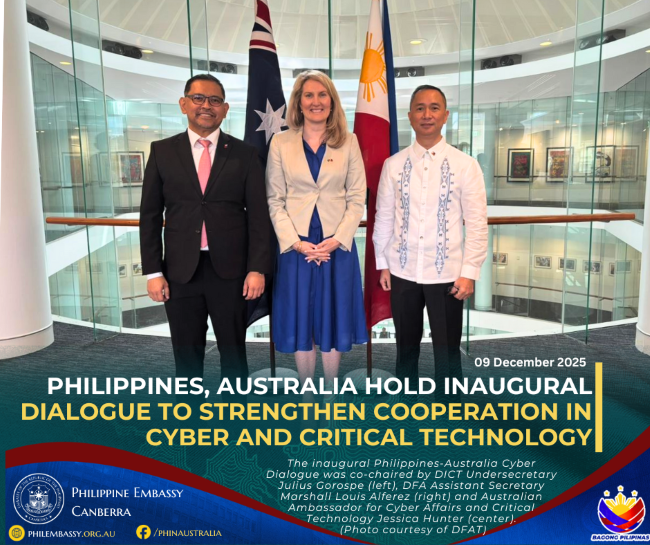
The Dialogue was co-chaired by Special Assistant to the Secretary for Cybersecurity Julius Gorospe of the Department of Information and Communications Technology (DICT) and Assistant Secretary Marshall Louis Alferez of the Department of Foreign Affairs (DFA) for the Philippine side, and Australian Ambassador for Cyber Affairs and Critical Technology Jessica Hunter, and Assistant Secretary for Cyber Policy and Programs Ashley Bell of the Department of Home Affairs (DHA) for the Australian side.
Discussions focused on strengthening cyber resilience and deepening collaboration between government and industry in critical technology. Both sides explored opportunities for closer cooperation in areas such as critical technology development, AI safety, and capacity building. They also emphasized the importance of expanding bilateral efforts to bolster defenses against cyber threats, especially those perpetrated by malign actors, and maintaining a trusted, secure and reliable digital environment.
The Philippines highlighted its National Cybersecurity Plan (NCSP) 2023-2028, which aims to strengthen government networks and critical infrastructure, raise public awareness of cybersecurity, develop a skilled cybersecurity workforce, and enhance national capabilities to respond effectively to cyber threats.
The meeting also underscored the enduring strength of the Strategic Partnership between the two countries, as the Philippines and Australia approach the 80th anniversary of diplomatic relations in 2026.
The 2024 Philippines-Australia MOU on Cyber and Critical Technology Cooperation provides the framework for ongoing collaboration, including sharing information and best practices on cyber and critical technology issues, developing cyber skills, strengthening digital economy connections, and enhancing multilateral coordination. END